Internal vs External Floating Roof Tanks
The Difference on the Top of Your Tank
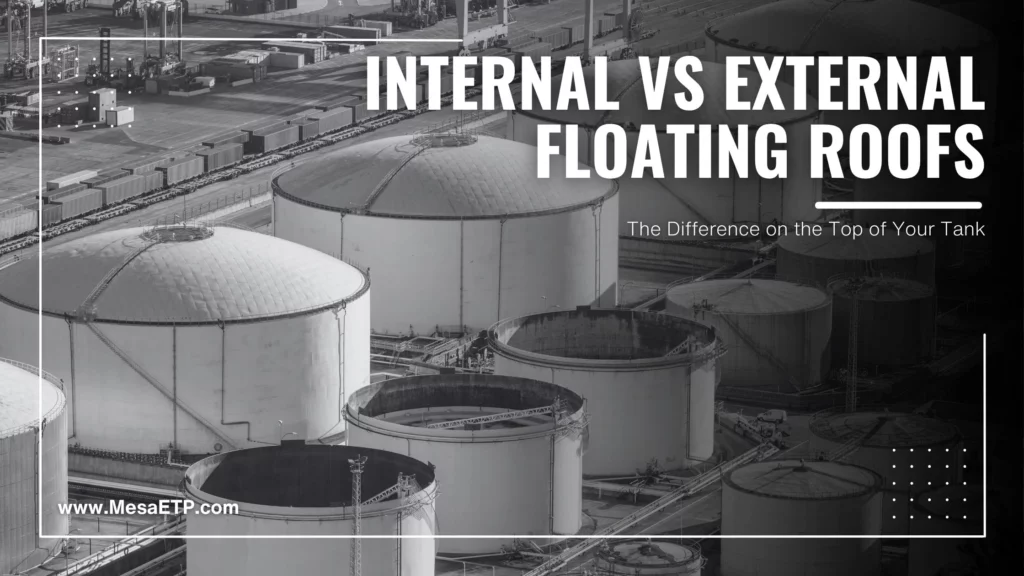
Large aboveground storage tanks are a critical part of the global energy infrastructure. From crude oil terminals to chemical storage, these tanks safely store massive volumes of volatile liquids like gasoline, ethanol, and refined fuels. One of the most important design choices in these tanks is what sits on top of the stored liquid. Understanding the differences between internal vs external floating roof tanks can help operators choose the most effective solution for emissions control and storage efficiency.
Floating roofs are engineered to reduce vapor losses, improve community and environmental safety, and help control emissions. Instead of leaving an open vapor space above the liquid, the roof floats directly on the product surface and moves up or down as the tank fills or empties. By minimizing the space where vapors can accumulate, floating roofs significantly reduce evaporative losses and volatile organic compound (VOC) emissions.
However, not all floating roofs are the same. In modern storage tanks, operators typically choose between External Floating Roof Tanks (EFRTs) and Internal Floating Roof Tanks (IFRTs). Understanding the difference between these designs is essential for selecting the right emissions control strategy and optimizing tank performance.
What Is a Floating Roof Tank?
A floating roof tank uses a buoyant roof that rests directly on the liquid surface, rising and falling as the product level changes. This design greatly minimizes the vapor space inside the tank and dramatically reduces evaporation and product loss compared to traditional fixed-roof tanks.
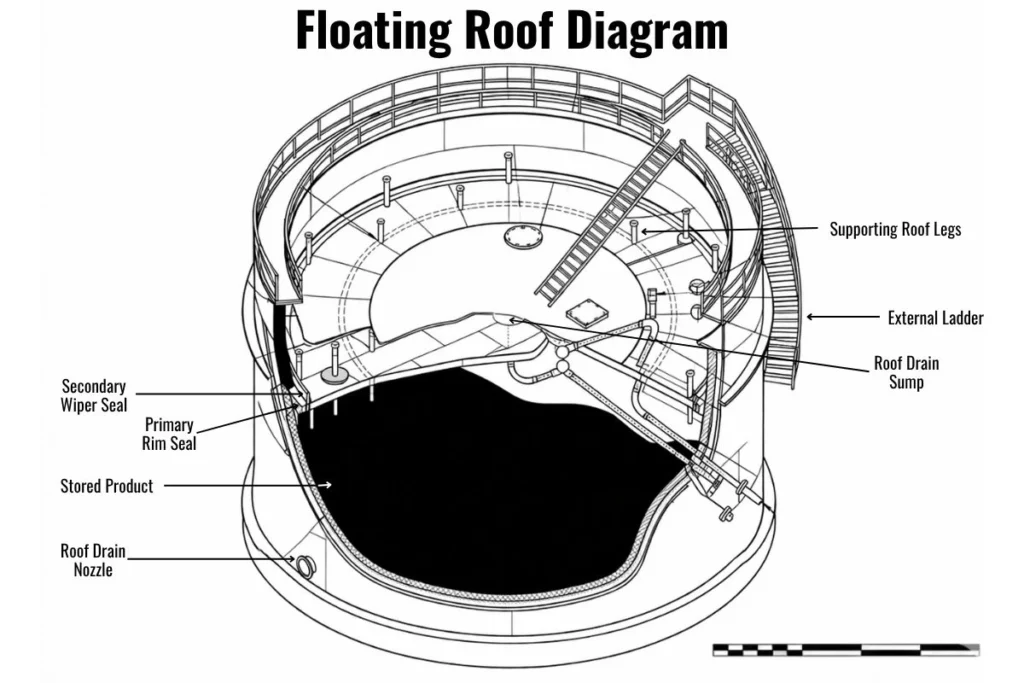
A seal around the perimeter of the floating roof – known as the rim seal – creates a tight barrier between the roof edge and the tank shell, further limiting vapor escape.
These systems are widely used in petroleum and petrochemical storage because they help facilities:
- Reduce VOC emissions
- Improve environmental compliance
- Protect product quality
- Minimize economic losses from evaporation
The two primary floating roof configurations differ mainly in where the floating roof sits in relation to the structure of the tank.
External Floating Roof Tanks (EFRTs)
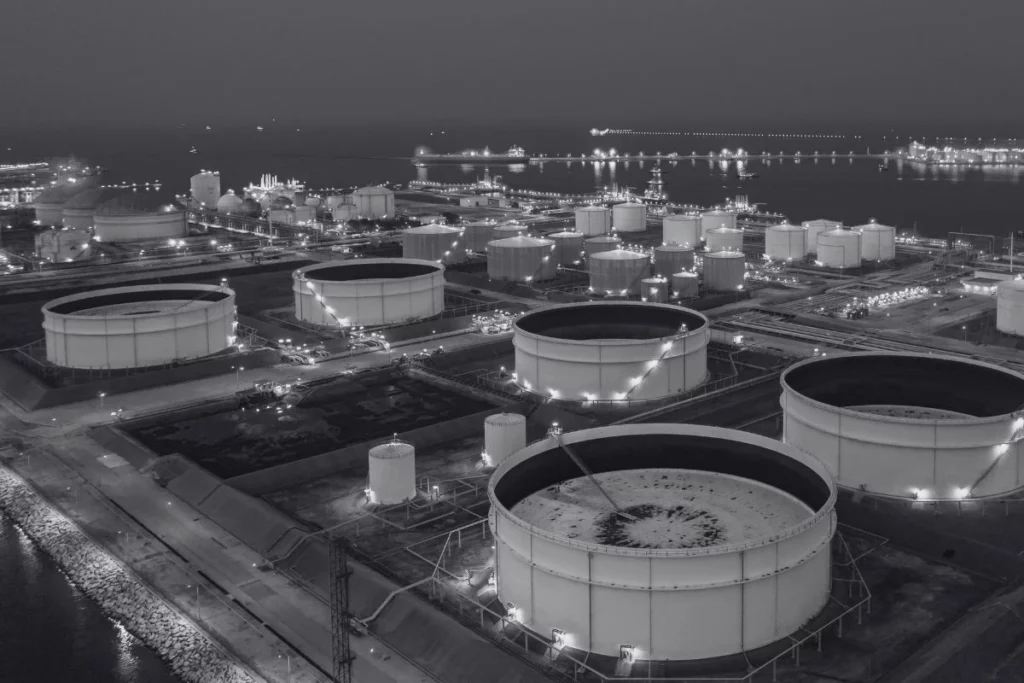
An External Floating Roof Tank is an open-top storage tank where the floating roof sits directly on the liquid and is exposed to the outside environment.
How EFRTs Work
In an EFRT, the tank has no permanent fixed roof. Instead, the floating roof forms the top surface of the tank. As the stored liquid level changes, the roof moves with it, maintaining contact with the product surface and limiting vapor space.
Because the roof is exposed to the elements, it typically requires:
- Roof drains to remove rainwater
- Rim seals to limit emissions
- Support legs that allow the roof to rest when the tank is nearly empty
Advantages of External Floating Roof Tanks
EFRTs are often selected because they offer:
- Lower construction cost due to a simpler design
- Effective vapor loss reduction compared to fixed-roof tanks
- Ease of inspection and maintenance in some operations
These tanks are commonly used for large-scale crude oil or diesel storage, particularly in regions with relatively mild weather conditions.
Limitations of EFRTs
The primary drawback of EFRTs is environmental exposure. Because the roof is open to weather, it can experience:
- Rainwater accumulation
- Wind movement
- Sunlight and corrosion
- Seal wear from environmental stress
These conditions can accelerate maintenance requirements and potentially increase emissions if seals degrade.
Internal Floating Roof Tanks (IFRT)
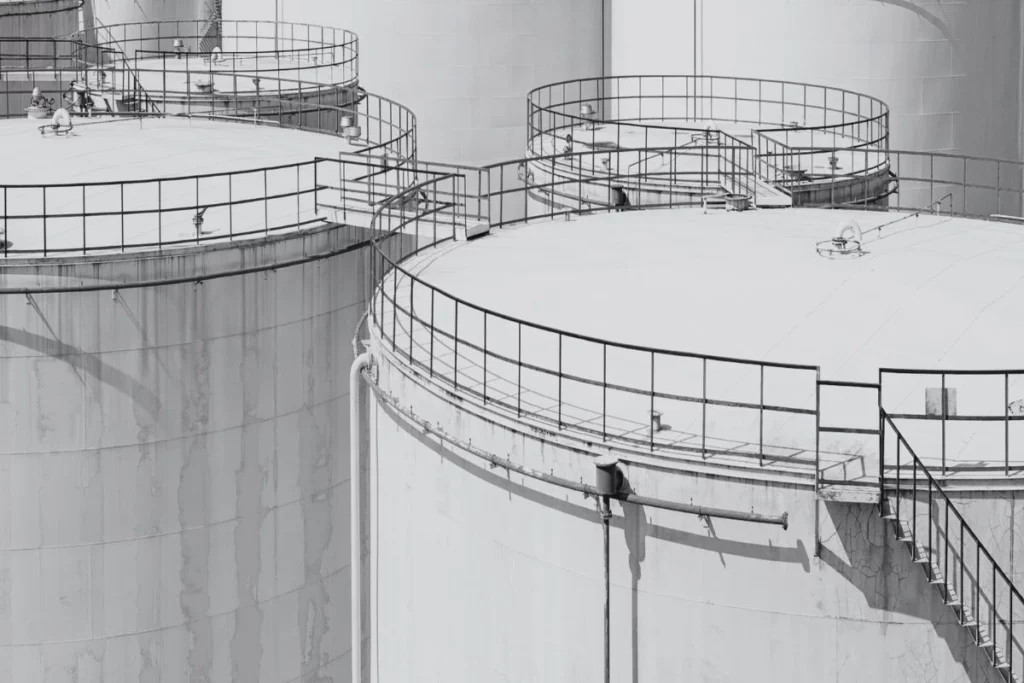
An Internal Floating Roof Tank includes two roofs:
- A fixed roof on the tank structure
- A floating roof inside the tank resting on the liquid surface
The internal floating roof performs the same function as an external one, but the fixed roof above it protects the system from the outside environment.
How IFRTs Work
The internal floating roof moves with the product level, minimizing vapor space and controlling evaporation. Because the system is enclosed within a fixed roof, the floating roof and seals are shielded from wind, rain, and sunlight.
Advantages of Internal Floating Roof Tanks
IFRTs are often preferred when:
- Strict emissions control is required
- The stored product has high vapor pressure (such as gasoline or jet fuel)
- Facilities must meet tight environmental regulations
The enclosure improves operational stability by preventing environmental forces from affecting the floating deck and seals. This can result in more consistent emissions performance and reduced risk of fire or ignition sources compared to open systems.
Limitations of IFRTs
Despite their benefits, internal floating roof tanks typically involve:
- Higher construction costs
- More complex installation
- Additional structural components
For some applications – particularly lower volatility products – operators may choose the simpler external floating roof design instead.
Key Differences Between Internal vs External Floating Roof Tanks
| Feature | External Floating Roof Tank | Internal Floating Roof Tank |
| Tank structure | Open-top tank | Fixed roof with internal floating deck |
| Environmental exposure | Roof exposed to weather | Floating roof protected by fixed roof |
| Typical applications | Crude oil, diesel, large terminals | Gasoline, volatile fuels, stricter emissions environments |
| Emissions control | Effective but weather-dependent | Generally more stable emissions control |
| Construction cost | Lower | Higher |
Both designs share the same goal: reducing emissions, product loss, and improving safety by eliminating the vapor space above stored liquids.
Where Tank Components Make the Difference
While the floating roof design is critical, performance often comes down to the components installed on the tank.
Key systems that influence emissions and operational reliability include:
- Primary and secondary rim seals
- Floating roof drain systems
- Vapor barrier fabrics
- Covers for roof openings
This is where custom engineered tank products play a major role. For example, advanced materials and installation systems can dramatically improve seal performance and durability over the lifetime of the tank.Mesa Engineered Tank Products develops solutions designed to improve reliability and emissions control in both internal and external floating roof tanks. Innovations such as Armor Fabric™ vapor barrier materials, ClipLock® fastener-free fabric attachment systems, and Resist-All-Clad® flexible, multi-coil roof drains are engineered to address common challenges like seal wear, emissions leakage, and maintenance complexity.
Choosing the Right Floating Roof Design
Selecting between an internal and external floating roof tank depends on several operational factors:
- Stored products
- Environmental regulations
- Climate conditions
- Emissions control targets
- Budget and lifecycle costs
In many modern facilities, engineers evaluate both tank configuration and component performance to ensure the storage system meets environmental, safety, and operational goals.
The Bottom Line for Internal vs External Floating Roof Tanks
Floating roof tanks remain one of the most effective technologies for controlling emissions and product loss in large hydrocarbon storage facilities.
- External floating roofs offer a simpler and lower-cost design.
- Internal floating roofs provide greater protection and emissions stability in demanding environments.
Regardless of configuration, the success of these systems often depends on the quality of the seals, drain systems, and vapor barriers installed on the tank – making engineered tank components a critical part of modern emissions control strategies.
References and Further Reading
Center Enamel. “Internal Floating Roof Tank vs External Floating Roof Tank.” Center Enamel, www.cectank.com/Internal_Floating_Roof_Tank_vs_External_Floating_Roof_Tank
EngineerFix. “How Floating Roof Tanks Work: Internal vs. External.” EngineerFix, www.engineerfix.com/how-floating-roof-tanks-work-internal-vs-external
Inspenet. “Internal Floating Roof Tank Function and Emission Control.” Inspenet, www.inspenet.com/en/articles/internal-floating-roof-tank-function
Kaiser, Mark J., and E. W. McAllister. Pipeline Rules of Thumb Handbook. Gulf Professional Publishing, 2023.
ScienceDirect. “Floating Roof Tanks.” ScienceDirect Topics, www.sciencedirect.com/topics/engineering/floating-roof-tanks
Monthly Archives
- September 2026
- August 2026
- July 2026
- April 2026
- November 2025
- October 2025
- June 2025
- May 2025
- March 2025
- February 2025
- December 2024
- November 2024
- May 2024
- April 2024
- January 2024
- October 2023
- August 2023
- May 2023
- April 2023
- June 2022
- May 2022
- September 2021
- July 2021
- January 2021
- August 2020
- July 2020
- May 2020
- April 2019
- January 2019
- November 2017
- October 2017
- July 2017
- June 2017
- May 2017
- April 2017
- February 2017
- November 2016