Floating Roof Drains Explained: Design, Types, and Why Flexible Drains Are Becoming the Industry Standard
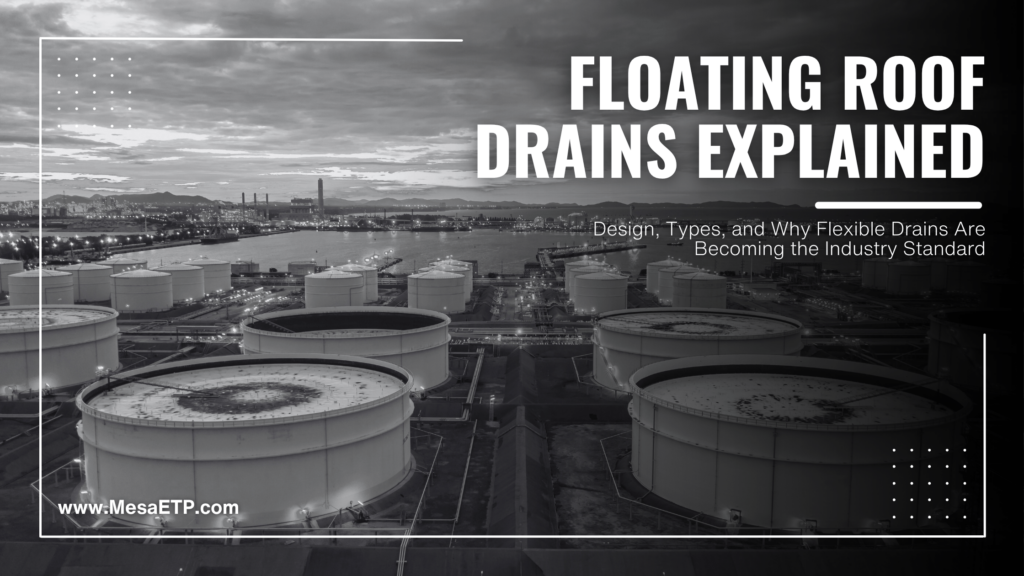
Aboveground storage tanks (ASTs) play a critical role in the oil, petrochemical, and chemical industries. Many of these tanks use floating roofs to reduce evaporative losses and control emissions from volatile liquids like crude oil, gasoline, and chemicals.
But floating roofs introduce a practical challenge: rainwater accumulation. Without a reliable way to remove water, even a well-designed tank can face structural risks, corrosion, operational issues, and potential environmental hazards.
That’s where floating roof drain systems come in. In this guide, we’ll explain how floating roof drains work, why they’re essential to emissions control and tank integrity, and why flexible floating roof drain systems are rapidly replacing older pivot style designs.
What Is a Floating Roof Tank?
A floating roof tank is an aboveground storage tank where the roof rests directly on the liquid surface, rising and falling as the tank fills or empties. This design dramatically reduces the vapor space above the liquid.
Reducing vapor space helps control emissions of volatile organic compounds (VOCs) – one of the main goals of environmental regulations governing storage tanks.
Federal rules such as the EPA’s 40 CFR 60 Subpart Kc require tanks storing volatile liquids to use emission control technologies such as floating roofs and sealing systems to limit vapor releases.
These systems are a key component of AST emission control and storage tank vapor control strategies.
Why Floating Roof Drain Systems Are Necessary
Even though floating roofs reduce vapor emissions, they are exposed to the environment. Rain, snow, and condensation accumulate on the roof surface.
If this water is not removed:
- The roof weight increases, potentially causing structural stress
- The roof may lose buoyancy or stability (potentially causing a spillover event)
- Corrosion and contamination risks increase
- Water may enter the stored product
To prevent these problems, floating roofs include roof sumps and drain systems that collect and remove the liquid that settles on top of the AST floating roof.
Most external floating roofs include one or more roof drains that carry water from the sump to a nozzle at the bottom of the tank shell, allowing the water to exit safely outside the tank.
How a Floating Roof Drain System Works
A typical floating roof drain system includes several components:
- Roof sump: A low point on the roof where rainwater collects
- Drain inlet: Allows water to enter the drain pipe while preventing product contamination
- Drain pipe: Transfers water from the roof to the tank floor outlet
- Tank shell nozzle: Where water and debris exit the tank safely
Because the roof constantly moves as the liquid level changes, the drain system must adapt to vertical movement, often over tens of feet.
This requirement is what differentiates modern flexible drains from older mechanical systems.
Types of Floating Roof Drain Systems
1. Pivot Style Drains
Historically, many tanks used articulated rigid pipe systems made from steel sections connected by joints.
These systems function like a mechanical arm, where two rigid pipes are connected by a joint (or elbow), allowing the drain to pivot as the roof moves up and down.
However, these systems have several limitations:
- Numerous mechanical joints
- Increased leak points
- Higher maintenance requirements
- Risk of joints binding or failing
- Higher chances of sediment or debris slogging joints or connections
Over time, operators began seeking alternatives with fewer failures.
2. Flexible Floating Roof Drain Systems
Flexible drain systems replace rigid pipes with continuous flexible hoses designed to move smoothly with the roof.
Modern flexible drains are engineered as a single or multi-coil continuous assembly that lays in a predictable pattern on the tank floor.
For example, Mesa Engineered Tank Products manufactures flexible floating roof drain systems such as Armor-Clad® and Resist-All-Clad®, which are engineered to drain rainwater and debris while accommodating constant roof movement.
These systems typically include:
- Flexible armored pipe
- Full-flow end fittings
- Superior chemical compatibility to reduce degradation
- Smooth internal fluidways
- Custom engineering for tank dimensions and rainfall data
Flexible drains eliminate the complex mechanical joints required by pivot-style drains, thereby removing the risk of a clog, failure, or slow draining.
Why Flexible Floating Roof Drains Outperform Pivoting Systems
Over the past two decades, flexible drain systems have become the preferred option for many tank operators. Think of your drain as a garden hose or straw, if there’s a kink or clog it won’t flow.
1. Fewer Leak Points
Flexible drains are often built as one continuous length, eliminating multiple couplings or pivot joints that can leak or fail.
This reduces:
- Product contamination risk
- Maintenance requirements
- Potential seal failures
2. Predictable Movement
Flexible drains are engineered to form a controlled coil or lay pattern on the tank floor.
Some systems use a single coil design that rises and lowers vertically with the roof, others use multiple coils and tethers to maintain a consistent position within the tank.
This predictable motion helps prevent pipe dragging, tank shell and floor abrasion, and interference with other tank components.
3. Higher Flow Efficiency
Flexible drains often use a smooth internal fluidway rather than corrugated piping. This design improves flow rates and prevents sediment buildup that could restrict drainage.
Better flow capacity ensures that large rainfall events can be handled without water pooling on the roof.
4. Longer Service Life
Modern flexible floating roof drains are engineered for harsh tank environments – including exposure to crude oil, gasoline, chemicals, and temperature fluctuations.
High-quality systems can remain in service for decades when properly installed and maintained.
The Role of Floating Roof Drains in Emission Control
Floating roof drains themselves do not control emissions directly, but they are essential to maintaining proper floating roof operation.
Regulations under U.S. environmental law require floating roofs and associated components to remain in proper operating condition to minimize emissions.
For example:
- Tanks must maintain continuous seals between the floating roof and tank wall to limit vapor escape.
- Roof openings and penetrations must be properly sealed or equipped with protective covers.
If excessive water accumulates on a roof, it can damage seals or alter roof performance – ultimately increasing VOC emissions.
Because of this, reliable roof drainage is an important part of AST emission control and regulatory compliance.
Engineering Considerations for Floating Roof Drain Systems
Designing an effective floating roof drain system requires careful engineering.
Key factors include:
- Tank diameter and roof height
- Roof travel distance
- Stored product compatibility
- Expected rainfall
- Internal tank components
Manufacturers like Mesa ETP custom engineer flexible pipe systems to match each tank’s dimensions and operating conditions, ensuring proper fit and long service life.
The Future of Floating Roof Drain Technology
As emissions regulations tighten and storage operators prioritize reliability, the industry is shifting toward:
- Flexible floating roof drains
- Integrated AST emission control technology
- Advanced seal materials and vapor barriers
Companies like Mesa Engineered Tank Products develop custom engineered tank products – including flexible roof drains, supporting roof leg boots, and gauge pole covers – to help operators meet evolving environmental standards while improving long-term tank performance.
The Breakdown
Floating roof drain systems may not be the most visible component of a storage tank, but they play a critical role in safe and efficient operation.
By removing rainwater and maintaining proper roof performance, these systems help protect:
- Tank structures
- Stored products
- Emission control systems
- AST regulatory compliance
As a result, flexible floating roof drains are increasingly becoming the industry standard, offering improved reliability, fewer leak points, and longer service life compared to older articulated drain designs.
References & Further Reading
Cornell Law School. 40 CFR §63.685 — Standards: Floating Roofs. Legal Information Institute, Cornell University
Environmental Protection Agency. Volatile Organic Liquid Storage Vessels (Including Petroleum Liquid Storage Vessels).
Environmental Protection Agency. Standards of Performance for Volatile Organic Liquid Storage Vessels (40 CFR Part 60 Subpart Kc).
Monthly Archives
- September 2026
- August 2026
- July 2026
- April 2026
- November 2025
- October 2025
- June 2025
- May 2025
- March 2025
- February 2025
- December 2024
- November 2024
- May 2024
- April 2024
- January 2024
- October 2023
- August 2023
- May 2023
- April 2023
- June 2022
- May 2022
- September 2021
- July 2021
- January 2021
- August 2020
- July 2020
- May 2020
- April 2019
- January 2019
- November 2017
- October 2017
- July 2017
- June 2017
- May 2017
- April 2017
- February 2017
- November 2016