‘Channel Hanger’ Mechanical Shoe Seal: Built for Tanks That Aren’t Perfect
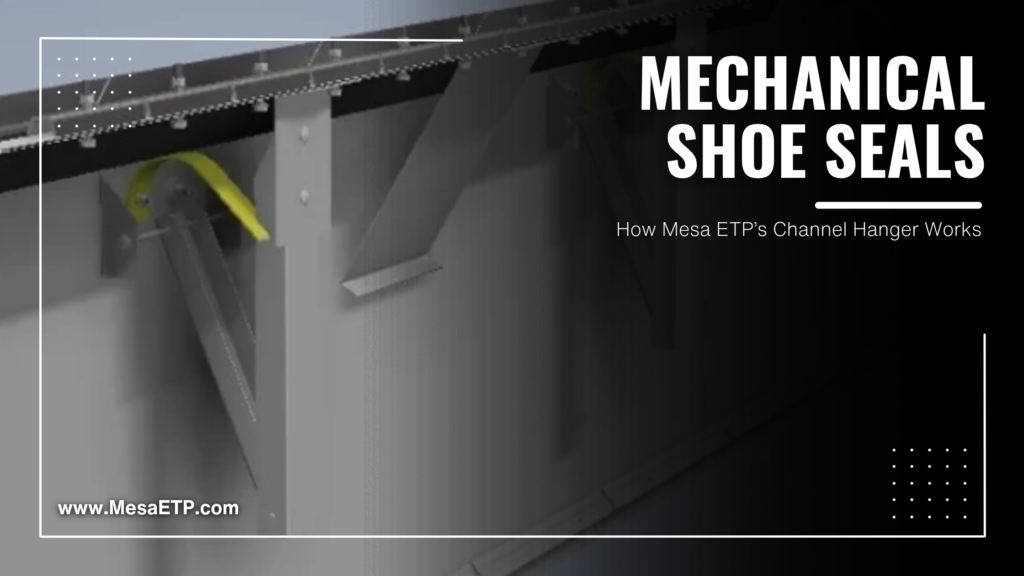
Look down at a floating roof tank from above and the gap between the roof and the shell barely registers. A few inches of empty space at the edge of a roof that can be hundreds of feet across. That’s where your mechanical shoe seal sits.
For such a little gap, it sure has some hefty consequences. If nothing blocks that space, vapors will find a way out. A floating roof tank rim seal closes the circular space around the roof and limits how much vapor reaches the atmosphere. Every inch of the circumference has to hold up, all day, every day, while the roof rises and falls.
Mesa Engineered Tank Products (Mesa ETP) designed the Channel Hanger mechanical shoe seal for that job. This is a look at how it works, where it fits, and what to consider when you’re choosing a primary seal for a floating roof tank.
What is a Mechanical Shoe Seal, Exactly?
Let’s start with the basics. A mechanical shoe seal presses a metallic ‘shoe’ against the wall of the tank. Many of these ‘shoes’ are fitted into a band that forms a ring around the roof, and the pivoting mechanisms and leaf springs hold them against the shell as the roof moves. According to the EPA’s AP-42 guidance, joints and other provisions let the ring expand and contract, so it can pass over tank irregularities and rivets.
But the shoe is only half of the seal system. A flexible, vapor barrier fabric runs from the shoe to the roof and forms an envelope around the rim’s vapor space. The EPA explains that the shoe and envelope together prevent direct contact between the annular vapor space and the atmosphere.
So the goal isn’t to lean a piece of metal on a wall. It’s to keep an unbroken barrier in place while the roof travels. Which raises the real question: how do you keep that shoe pressed continuously against a tank shell that isn’t perfectly uniform?
How a Mechanical Shoe Seal Keeps in Contact
The Channel Hanger answers this dilemma with gravity. It’s designed so the bracing shoe is naturally pushed toward the shell, which helps hold a tight, consistent seal as the roof moves. Independent hanger and pusher mechanisms let the shoe respond to what the shell is doing at any given point.
Real tanks aren’t always textbook perfect. Variations in construction, tight rim spaces, rivets, welds, and other surprises can complicate seal installation. The Channel Hanger is designed with these real-world conditions in mind, delivering a practical fit without relying on perfectly uniform tank walls.
And because every tank is different, the design goes beyond a one-size-fits-all approach.
Custom Engineering for Every Tank

Every Channel Hanger mechanical shoe seal is custom engineered for the tank it’s going into. Mesa ETP’s engineers account for individual tank variances and irregularities while keeping a tight fit around the roof.
That customized approach also opens up some flexibility for engineering teams because the Channel Hanger accounts for:
- Horizontal or vertical installation, depending on what the tank requires
- Welded or riveted shells
- Internal or external floating roof tanks
- 304 stainless steel for the mechanical shoe components
Stainless steel is just the starting point. The Channel Hanger brings together carefully engineered shoe connections, hanger and pusher mechanisms, and tank-specific configurations to deliver a seal designed for real-world tank conditions. Just as important, Mesa ETP’s seals, including the Channel Hanger, are manufactured in the USA at our Cincinnati, Ohio, and Houston, Texas, facilities using primarily American-sourced materials.
That commitment to domestic manufacturing is built into the product, right down to the details. And one of those details makes a big difference: how the shoes connect to one another.
Tight-Fitting, Minimum-Gap Sealing
The Channel Hanger uses overlapping shoe-to-shoe slip joints, which let individual sections move while the seal stays in continuous contact around the full circumference of the storage tank, creating a tight-fitting, minimum gap rim seal.
Think of it as a ring that can flex where the shell asks it to, without opening a gap. The EPA describes the primary rim seal as the component that closes the annular space between the floating deck and the tank wall, with the purpose of controlling vapor movement through that space. The slip joints help the Channel Hanger do that around the whole tank.
Mechanical Shoes and Other Rim Seal Options
Of course, a mechanical shoe isn’t the only way to get there. The EPA identifies three basic types of primary seals for floating roofs: mechanical shoe, resilient-filled, and flexible wiper.
Resilient-filled seals, like foam log seals, use a compressible material to maintain shell contact as the rim space changes. Mechanical shoe seals take a different route, with a metal shoe and a mechanical system doing the work.
Choosing the right floating roof storage tank seals depends on the tank, the stored product, operating conditions, applicable regulations, and other project details. The Channel Hanger is for tanks where a mechanical shoe is the right fit.
Mechanical Shoe Seals for Crude Oil
Some stored products (like crude oil) can leave wax or sticky deposits on the tank shell. For ‘stickier’ products like Bitumen or Bunker Fuel, the Channel Hanger is available with an optional wax scraper attachment. It addresses buildup where the shoe meets the shell, right where deposits can interfere with contact.
Keep Your ROI: Install While In-Service
Unfortunately for tank operators, seals don’t typically wear out when it’s convenient to take a tank offline. That’s why Mesa ETP’s Channel Hanger mechanical shoe seal offers in-service installation, which gives tank owners another option when planning a replacement or upgrade. A full shutdown doesn’t have to be baked into the project by default.
If you’re already thinking about the fabric side of the job, there’s an option that simplifies that too.
Compatible with ClipLock®

The Channel Hanger can be paired with Mesa ETP’s ClipLock®, a fabric attachment system that does away with traditional bolts and fasteners. No bolts means no slits or cuts needed in the fabric for attachment, helping maintain a tighter barrier against vapor emissions.
Less time installing and less time on the tank. ClipLock cuts installation time by 50%, reducing the time crews spend working on your tanks, while helping lower labor costs and improve project ROI. It’s a faster installation with benefits that extend well beyond the job itself.
ClipLock also holds approval from the South Coast Air Quality Management District (SCAQMD), an important consideration when evaluating seal components for regulatory compliance.
Approved by SCAQMD
For facilities under air-quality regulations, a seal has to satisfy the rulebook as well as the engineering. The South Coast Air Quality Management District’s Rule 463 Approved Tank Seals list includes Mesa Industries’ Mechanical Channel Hanger Shoe with ClipLock as a Category A primary seal. It received SCAQMD approval in 2023 for both internal and external floating roof tanks, as well as tanks which have riveted or welded shells.
Mesa ETP’s mechanical shoe primary rim seal also meets the EPA’s AP-42 requirements, and is BAAQMD compliant.
Regulatory approval like this gives engineers, tank owners, and operators something concrete to point to when they evaluate a primary seal.
The Bigger Primary Seal Picture
There’s no single right answer for every tank. Start with the details that shape the decision:
- Tank construction
- Roof type
- Stored product
- Rim space
- Operating conditions
- Regulatory requirements
Tanks move, flex, and vary. The right seal will account for all of it.
Mesa ETP can evaluate your tank and recommend the right seal configuration. Talk to a Tank Expert about the Channel Hanger mechanical shoe seal.
Channel Hanger Features at a Glance
- Gravity-assisted design that helps maintain shoe-to-shell contact
- Independent hanger and pusher mechanisms
- Tight-fitting, minimum-gap sealing
- Shoe-to-shoe slip joint connections
- American sourced. American made.
- Allowance for tank variations and irregularities
- Custom design for each tank
- Horizontal or vertical installation
- Welded or riveted tank compatibility
- Internal and external floating roof compatibility
- 304 stainless steel shoe components
- In-service installation
- Optional wax scraper for crude oil and sticky products
- ClipLock® compatibility
Frequently Asked Questions (FAQs)
What is a mechanical shoe seal for a floating roof tank? It’s a primary rim seal for aboveground storage tanks that utilize a floating roof. The mechanical shoe seal uses a mechanical shoe held against the tank shell. A vapor barrier fabric connects the shoe to the roof and forms a vapor barrier around the rim space. It is also called a metallic shoe seal.
Can the Channel Hanger be used on riveted tanks? Yes. It works with both welded and riveted shells.
Does it work on internal and external floating roof tanks? Yes. It can be used on both internal and external floating roof tanks.
Can it be installed while the tank is in service? Yes. It can be installed while a tank is in-service. Mesa ETP also offers complementary installation supervision if needed.
Is Mesa ETP’s Channel Hanger mechanical shoe seal approved by SCAQMD? Yes. The Channel Hanger is SCAQMD, BAAQMD, and EPA approved.
References & Further Reading
U.S. Environmental Protection Agency. Technical documentation on floating roof rim seals, EPA National Service Center for Environmental Publications (NEPIS). nepis.epa.gov, document P1019BB1
U.S. Environmental Protection Agency. AP-42 guidance on floating roof tank seals, NEPIS. nepis.epa.gov, document 9100IFLX
U.S. Environmental Protection Agency. Technical documentation on mechanical shoe seals and the fabric envelope, NEPIS. nepis.epa.gov, document 20011SSC
South Coast Air Quality Management District. Rule 463 Approved Tank Seals. aqmd.gov, R463ApprovedTankSeals.pdf
Monthly Archives
- October 2026
- September 2026
- August 2026
- July 2026
- April 2026
- November 2025
- October 2025
- June 2025
- May 2025
- March 2025
- February 2025
- December 2024
- November 2024
- May 2024
- April 2024
- January 2024
- October 2023
- August 2023
- May 2023
- April 2023
- June 2022
- May 2022
- September 2021
- July 2021
- January 2021
- August 2020
- July 2020
- May 2020
- April 2019
- January 2019
- November 2017
- October 2017
- July 2017
- June 2017
- May 2017
- April 2017
- February 2017
- November 2016